
Criminal Court Records in Houghton County
A criminal court record is the official case file a court opens when a person is formally accused of a crime. In Houghton County, the clerk starts that file the moment the prosecuting attorney charges someone, and it grows with every document filed after. The file collects the complaint, the charge list, bond paperwork, hearing notices, motions, and the judge's final orders. It is a case-level record, which is broader than a single arrest report or a printout of the charges alone. For a closer look at the charges themselves, the arrest records and court charges page breaks them down, and the wider Houghton County court records page covers civil, family, and probate files too.
Two trial courts handle criminal matters here. The 97th District Court hears misdemeanors, traffic offenses, and the early stages of felony cases, including the arraignment and the preliminary examination. The 12th Circuit Court, the county's main trial court, takes felony cases once they are bound over, along with the most serious charges. Both sit inside the Houghton County Courthouse on East Houghton Avenue. The Houghton County Prosecuting Attorney, Daniel J. Helmer, decides which charges to bring and represents the state at each stage of the case.
The county lists the office that files criminal charges on its Prosecuting Attorney directory page, along with staff names and the email addresses used for filing and discovery.
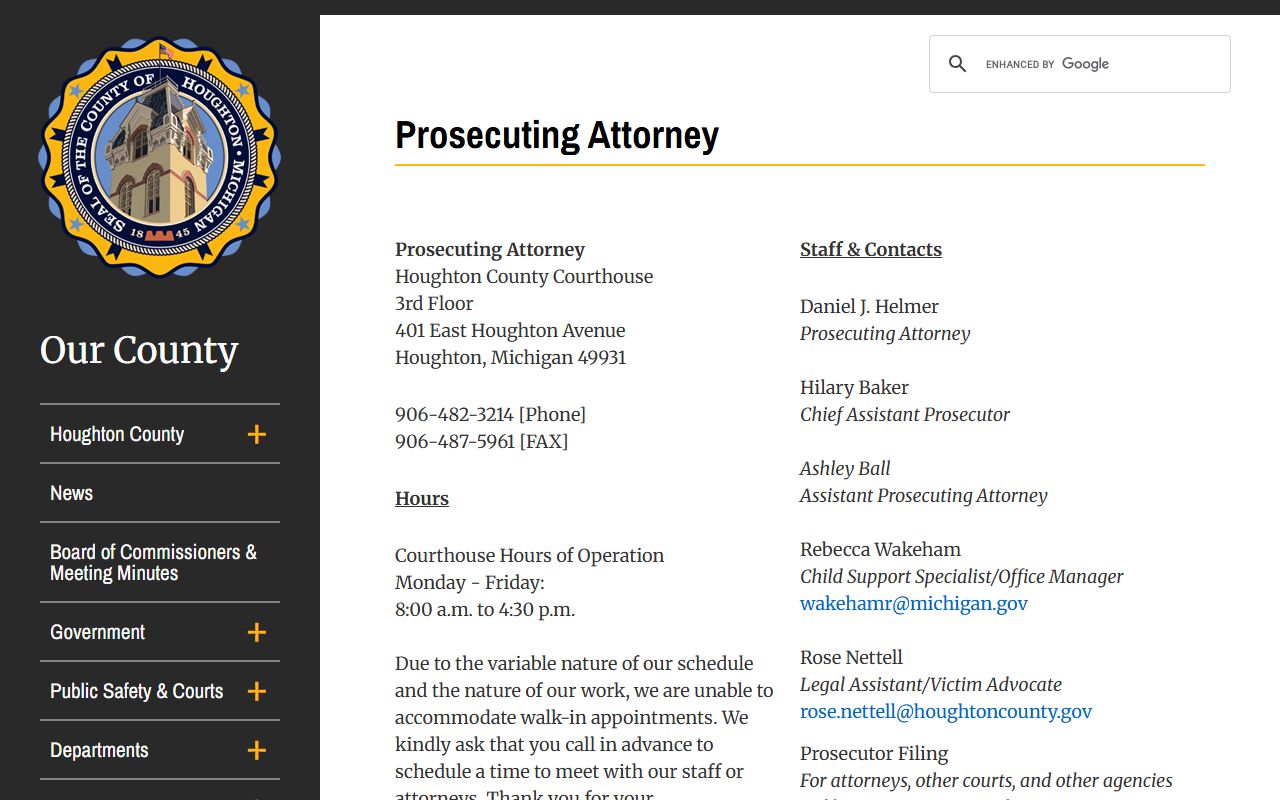
Every criminal court record in the county traces back to a charging decision made by that office, so the prosecutor is a useful starting point when a file raises questions the docket does not answer.
How to Search Houghton County Criminal Court Records
The county does not run its own case-search engine. The practical public path is the Michigan Courts case-search system, plus the court-specific shortcuts the county posts for the 12th Circuit and 97th District courts. These tools cover criminal, civil, traffic, family, and probate cases that have been entered into the state system.
- Open the Michigan Courts case-search system at courts.michigan.gov/case-search or the MiCOURT case search.
- Use the 12th Circuit shortcut or the 97th District shortcut to focus on Houghton County.
- Search by defendant name or case number.
- Narrow the results by court, case type, and filing date to reach the right file.
- Open the case to read the docket, charges, and disposition, then request a certified copy from the clerk if you need one for legal use.
The statewide system is a public service, but it does not carry every older paper file, and it does not display sealed, juvenile, or confidential matters. Certified copies for court use still come from the clerk who holds the file. When a record is missing from the online index, the next step is the circuit or district court office that owns it, followed by a public-records request where one applies.
Stages of a Criminal Case
A criminal case moves through a set order of steps, and each step adds an entry to the court record. Reading a file from top to bottom shows how far a case traveled and where it ended. The same stages apply whether a case starts in the district court or is bound over to the circuit court.
Case flow: Charges Filed › Arraignment › Pretrial / Motions › Plea or Trial › Disposition › Sentencing
| Stage | What Happens |
|---|---|
| Arraignment | The first court appearance, where the judge reads the charges, sets or reviews bond, and takes an initial plea. |
| Pretrial / Motions | Both sides exchange discovery, argue motions, and often discuss a plea. Felony cases include a preliminary examination in the district court. |
| Plea or Trial | The defendant pleads guilty or no contest, or the case goes to a bench or jury trial that ends in a verdict. |
| Sentencing | After a plea or a guilty verdict, the judge imposes the sentence, which can include jail, prison, probation, fines, or a mix. |
What a Houghton County Criminal Court Record Shows
The public view of a criminal file is built from a set of standard fields. Michigan case-search results for Houghton County show the court name, case status, parties, attorneys, and filing dates, and the full docket adds the charges, pleas, and rulings behind those headings. Reading the fields together tells you who was charged, with what, and how the case ended.
| Field | What It Shows |
|---|---|
| Case Number | The unique file number the clerk assigns, used to pull every document in the case. |
| Court | Which court holds the file, such as Houghton Circuit Court or Houghton District Court. |
| Defendant | The person answering the charges, listed with the party role. |
| Filing Date | The date the case was opened, which starts the record's timeline. |
| Charges | Each count as filed, tied to a statute and a severity level. |
| Plea | How the defendant answered each count: guilty, not guilty, or no contest. |
| Disposition | How the court resolved each count, such as convicted, dismissed, or acquitted. |
| Sentence | The penalty imposed after a conviction, from fines and probation to jail or prison. |
| Case Status | The stage of the file, with entries like Case Concluded, Closed, or File Archived. |
Charges vs. Convictions in Houghton County
A charge is only an accusation. A conviction is a finding of guilt. A criminal court record can show charges that were later dropped, dismissed, reduced, or that ended in an acquittal, and none of those outcomes is a conviction. This matters when reading an old file, because the top charge listed at filing is not always the charge a person was found guilty of.
| Charge | Conviction | |
|---|---|---|
| Stage | Accusation at filing | Verdict or accepted plea |
| Burden of Proof | Probable cause | Beyond a reasonable doubt |
| Decided By | The prosecuting attorney | Judge or jury |
| Public Record | Yes | Yes |
Because the two are not the same, a careful reader checks the disposition line for every count before drawing a conclusion about a case.
Reading Dispositions and Sentences
The disposition is how the court closed each count, and the sentence is what the judge ordered once a count ended in a conviction. These two lines are the heart of the record, and they use a small set of terms that repeat across files.
- Guilty - the defendant admitted the charge or was found guilty at trial.
- Not guilty - a plea, or an acquittal after trial.
- No contest - the defendant did not admit guilt but accepted the penalty.
- Dismissed - the court dropped the count, sometimes as part of a plea deal.
- Deferred - judgment is held back while the defendant meets conditions, and may later be dismissed.
A sentence can combine several parts: jail or prison time, probation, fines and costs, restitution to a victim, and program conditions. Probation puts a person under supervised release in the community, while a prison sentence sends a felony offender into state custody. The record notes the length and terms of each part so the reader can see the full penalty.
Note: A sentence that includes probation is supervised in the community, so the person may not appear in any jail or prison roster at all.
Supervision Records and OTIS in Houghton County
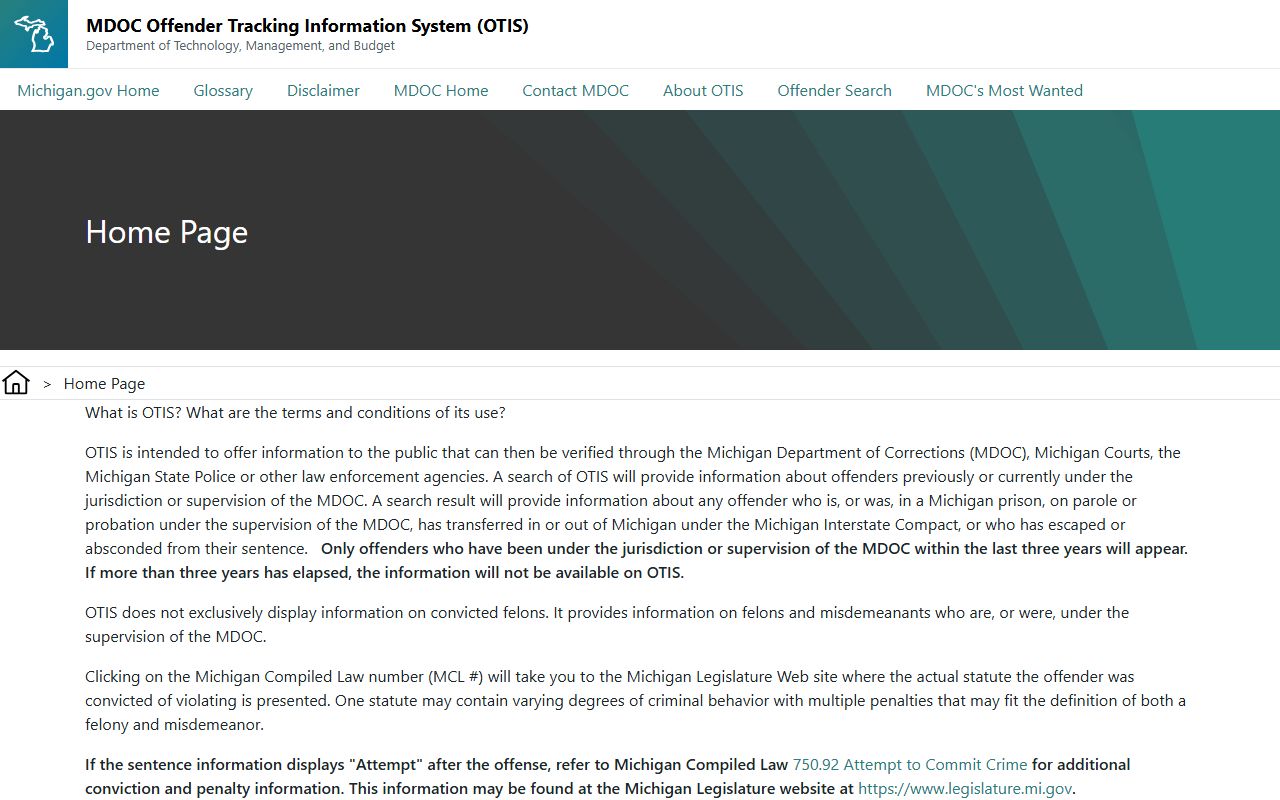
Once a felony sentence is imposed, the offender may move into state custody or state supervision, and that side of the record lives in a different system than the court docket. The Michigan Department of Corrections runs the Offender Tracking Information System, known as OTIS, which lists prisoners, parolees, and probationers under state jurisdiction. It is the fastest way to confirm where a sentenced person is held and when they may be released.
The department keeps the tool at its OTIS home page, where a name search returns matching offenders under corrections jurisdiction.
A result opens into a full profile, which is more detailed than a court docket line and includes the sentence, location, and status.
Each OTIS offender profile shows the MDOC number, physical description, current status, assigned location, earliest release date, and the prison or probation sentences tied to the person.
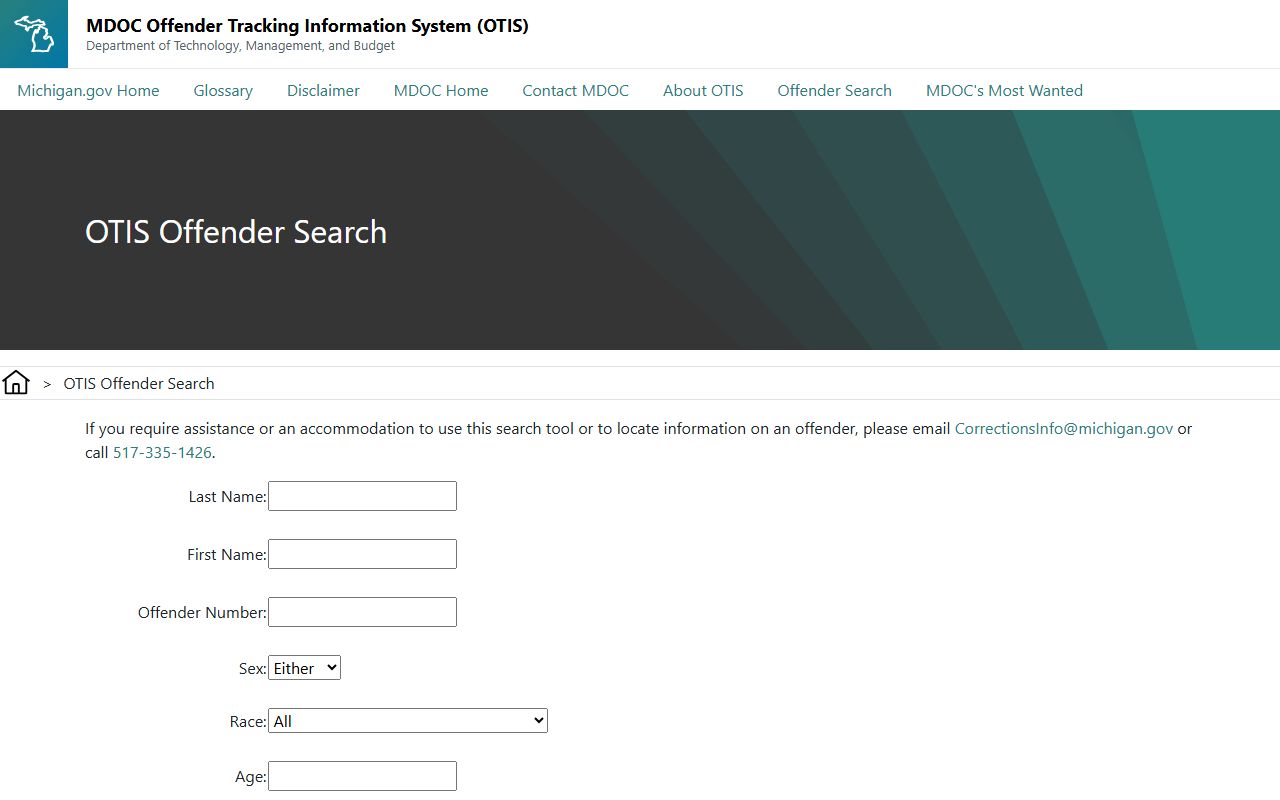
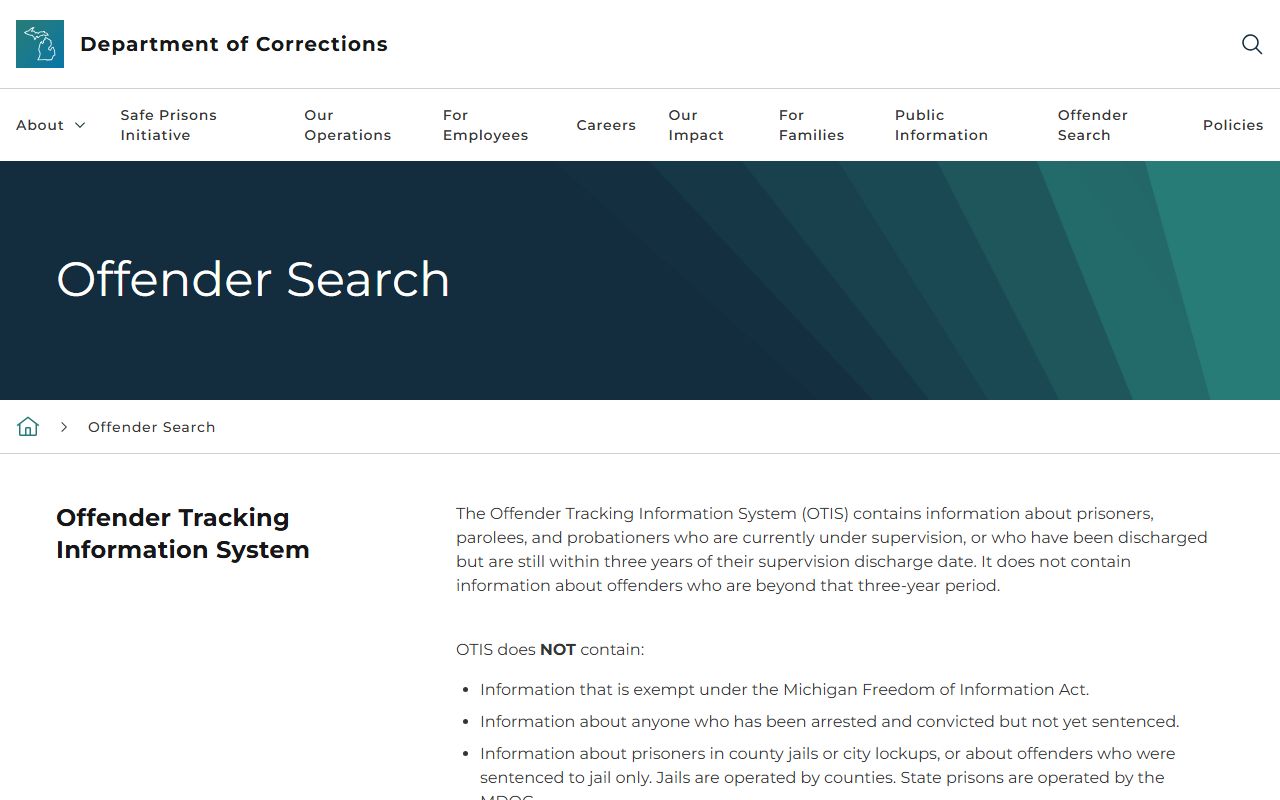
One point trips up many readers: OTIS covers people under state corrections jurisdiction, not everyone with a Houghton County case. Circuit-court probationers are county-supervised, and county jail custody is separate from state custody, so a person in the county corrections facility will not always show in OTIS.
The state also explains the system's scope and limits on its Department of Corrections OTIS page, which is worth reading before drawing conclusions from a search.
Together, the court docket and OTIS give the full arc of a felony case, from the charge through the sentence and into supervision or release.
Sex Offender Registry Records in Houghton County
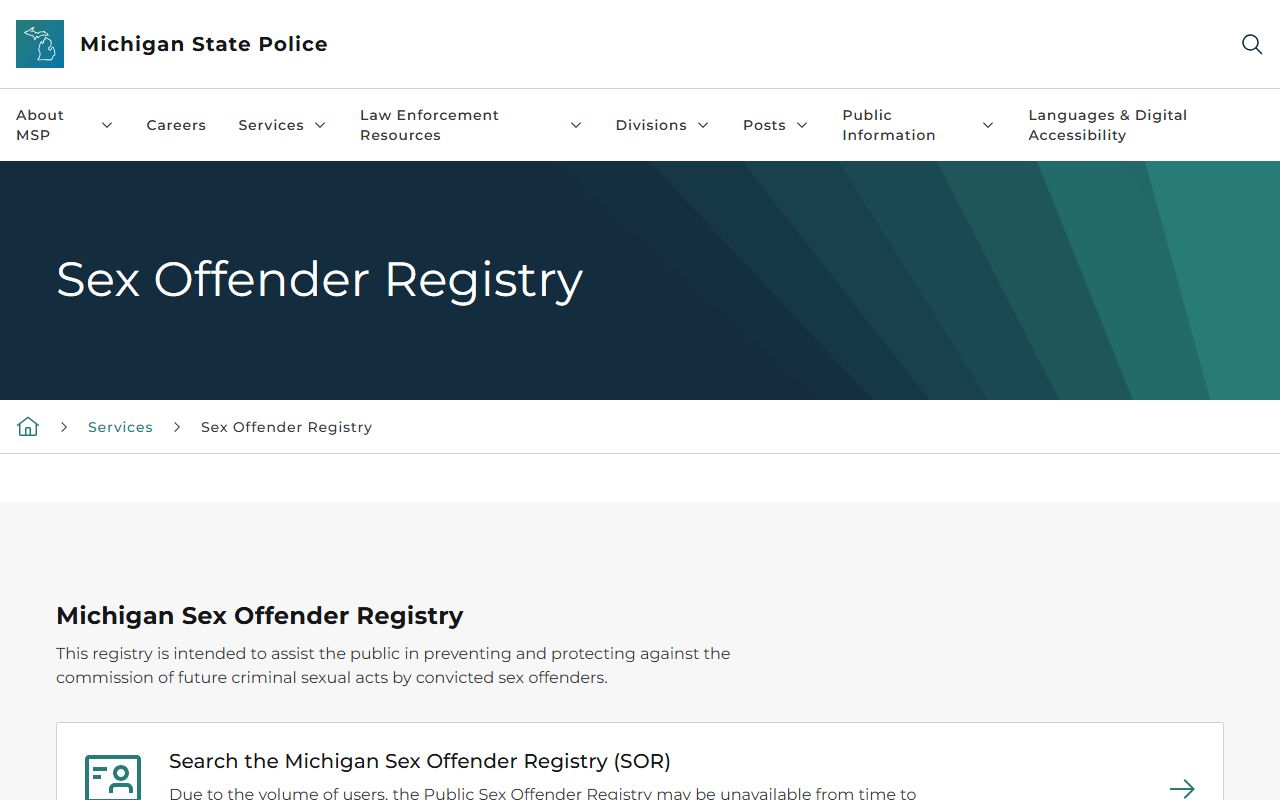
Certain convictions carry a separate public consequence: registration on the Michigan Sex Offender Registry. That registry is its own record, run by the Michigan State Police, and it is not the same as the court file or OTIS. It lists people required to register, along with their photo, address range, and the offense that triggered the requirement.
The state police describe the program and the rules on the Michigan sex offender registration page, which explains who must register and for how long.
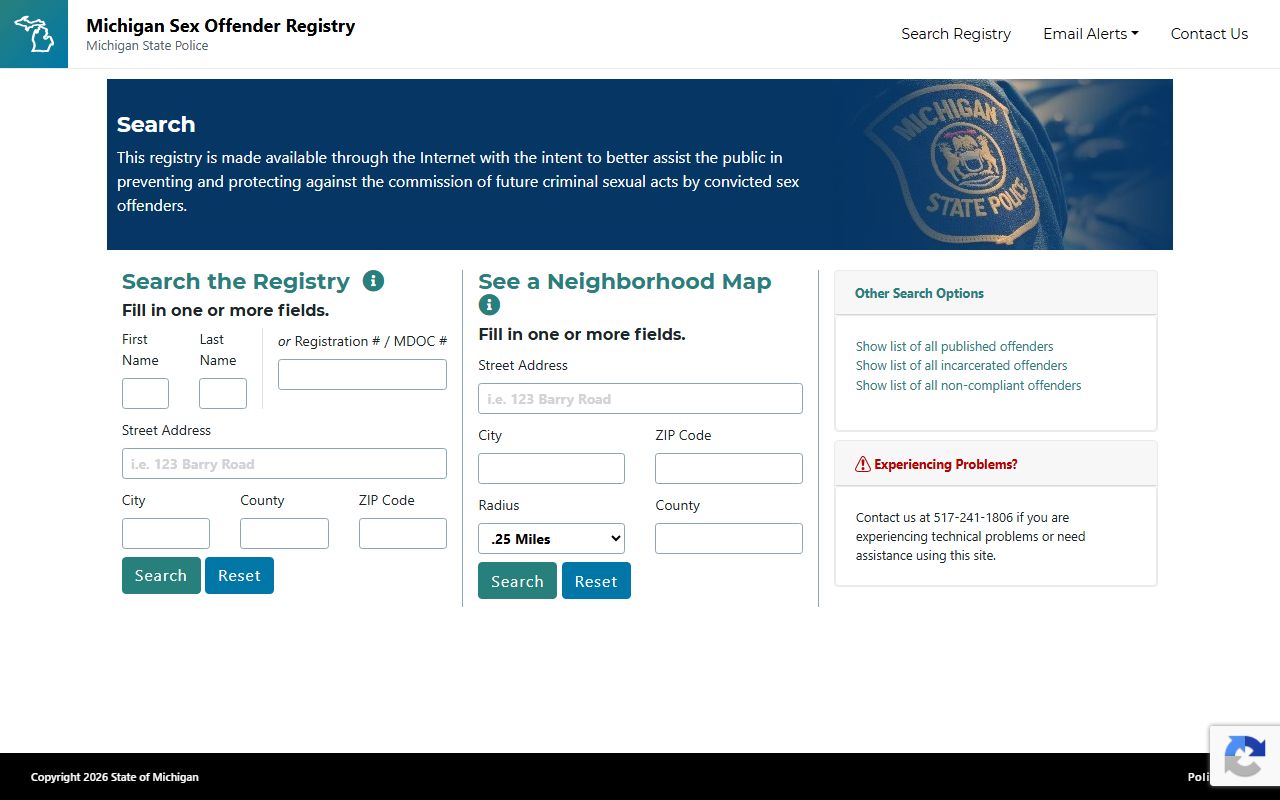
The public can then run a name or location search through the registry's own search tool.
The Michigan Public Sex Offender Registry search lets anyone look up registrants by name or by area, which is useful for confirming a status the court file alone will not show.
A registry entry follows a conviction but is maintained apart from the docket, so a full picture of a case may draw on the court record, OTIS, and the registry at the same time.
Sealed vs. Expunged Records
Not every criminal record stays public forever. Michigan lets eligible people set aside, or expunge, certain convictions under MCL 780.621, which removes them from the public criminal-history view. Sealing is narrower and hides a record from ordinary public search while some agencies keep limited access. The two terms are often mixed up, so it helps to keep them apart.
| Sealed | Expunged | |
|---|---|---|
| Visibility | Hidden from public search | Set aside and treated as if it did not occur publicly |
| Law Enforcement | Limited access | Very limited; retained in some statutory systems |
| Michigan Basis | Case-specific orders, such as domestic-violence sealing under MCL 600.2972 | Set-aside of convictions under MCL 780.621 and related sections |
| Eligibility | Depends on the statute and the judge's order | Depends on offense type, waiting periods, and number of convictions |
Anyone seeking an expungement checks eligibility first, confirms the waiting period, gathers certified copies of the judgment, and files the petition with the court that handled the case. If granted, the public-facing record becomes limited or removed, though agencies may still hold internal history.
Public Access to Houghton County Criminal Records
Michigan treats court records as open by default, and criminal case files are public unless a statute or a judge limits them. The state Freedom of Information Act and the court-records rule set the framework, and the expungement statute explains how a record can later leave the public view. When a file is not online, these laws govern the request that follows.
Key Statutes:
Michigan FOIA, MCL 15.231 - starts from the rule that government records are open unless a law says otherwise.
MCR 8.119 - makes Michigan court records public by default while keeping document images off the open internet.
MCL 780.621 - the main statute people use to set aside or expunge eligible convictions.
Background Check Considerations
A casual name search on a court portal is not the same as a formal background check. Employers, landlords, and lenders that make decisions based on criminal history must follow the federal Fair Credit Reporting Act and use a regulated screening company. A statewide criminal-history check runs through the Michigan State Police, and the court docket is only one input among several.
Important: This site is not a consumer reporting agency under the FCRA, and its information cannot be used for employment, housing, credit, or other FCRA-regulated screening.
Restricted Criminal Court Records in Houghton County
Some criminal matters never reach the public index, or appear only in part. Juvenile cases run through the family division and are open only by court order under MCL 712A.28, so names and details are usually suppressed. Sealed and set-aside cases drop out of public search once a court grants the request. Ongoing investigations, grand-jury material, and files a judge has restricted also stay closed.
Even in a public file, the court redacts personal identifiers such as Social Security numbers, financial-account data, and the names of minors. The public version of a record is not the same as the full internal file, so a redacted docket is normal and not a sign that something is missing.